

Contributions to Diversity
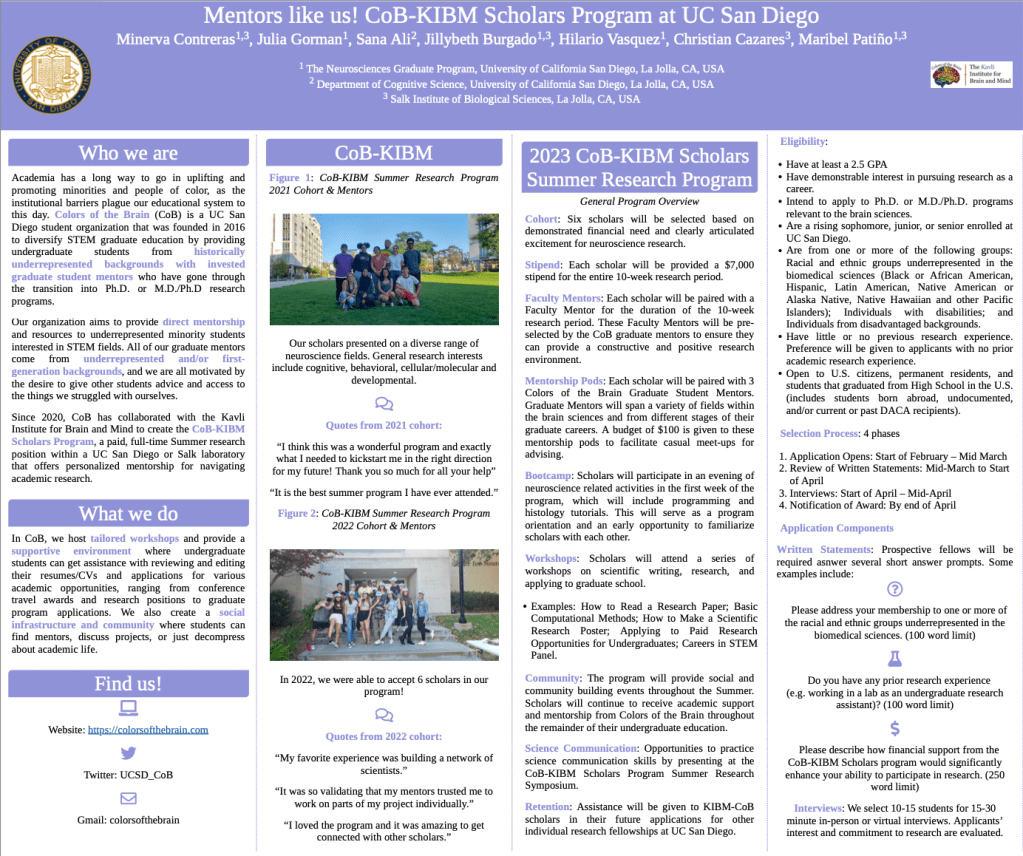
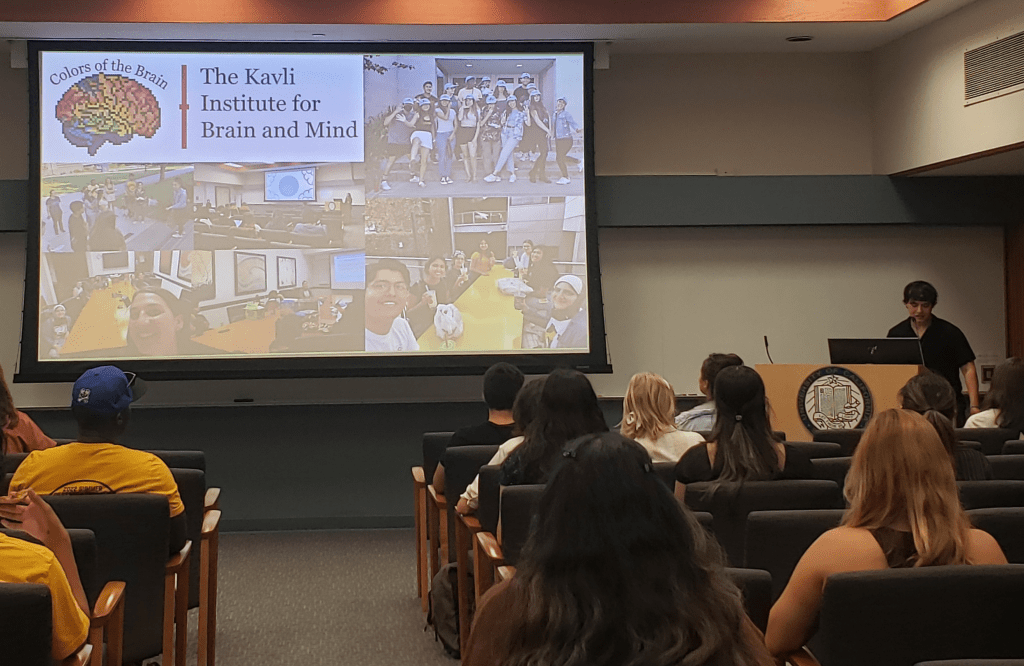
In 2016, as a first-year graduate student at UCSD, I founded Colors of the Brain, a program to promote the inclusivity of minoritized undergraduates in neuroscience by providing professional networks, research training, and financial empowerment. As the leader of our award-winning, grassroots organization, I’ve organized over 50 research professional development events for hundreds of San Diego area students over a period of 8 years. In 2020, I led Colors of the Brain and secured funding from the Kavli Institute for Brain and Mind to launch a new undergraduate summer research program. Our program currently offers the highest student stipends among UCSD summer undergraduate research programs, primarily motivated by our desire to ensure that financial needs would not cause our scholars to doubt their commitment to a research career. Without staff support, I faced the challenge of assembling a team capable of administering the program. I created a program template and pitched it to colleagues. Within a month, I enlisted over 20 graduate students from the Neurosciences Graduate Program, the Psychology Department, and the Cognitive Science Department at UCSD who shared my mission to provide positive research experiences to historically marginalized undergraduates. This grassroots effort, with feedback from my diverse team, involved coordinating advertising, forming an admission committee, establishing mentorship pods, designing a professional development curriculum, and creating surveys to track scholar outcomes. I could not have done this alone. Having managed over $150,000 of funds to serve 4 annual cohorts totaling 25 undergraduates, we have come full circle: multiple scholars have been accepted into UCSD graduate programs, and one now serves as a key leader within our organization. I am deeply committed to ensuring the enduring influence of this initiative. With the foresight that this program should outlast me, I registered our organization as a California non-profit (501c3), wrote a commentary manuscript on our lessons learned (accepted in principle in Nature Neuroscience), and mentored three outstanding graduate students who now serve as program co-directors.
My bilingual and international outreach activities ideally position me to significantly contribute to the UCSD Cognitive Science department’s culture of inclusivity, especially as UCSD is an Emerging Hispanic-serving Institution. Like many immigrants, education was my path to social mobility. However, many educational opportunities in the US often exclude Spanish-speaking communities, despite Hispanic peoples being the nation’s second largest ethnic group. I value building trust between neuroscientists and underserved groups because otherwise, we risk lacking inclusion from all populations that scientists are meant to serve. Therefore, to ensure Spanish speakers in my home community feel included in the scientific process, I established BrainBorders in 2022. In this outreach organization, funded by The American Society for Cell Biology, I collaborate with my former high school to offer bilingual neuroscience education materials and career guidance to students in our US-Mexico border town. Emboldened by its success, I leveraged my professional network in 2023 to co-found Community and Science Advancements in Spanish (CASAS), a well-attended, monthly research seminar series at UCSD that promotes science dissemination in Spanish to the San Diego / Baja California community at large. This initiative, led by faculty in the UCSD Biology department, underscores my efforts to extend my science communication skills in cognitive science to diverse science communities on campus. I am deeply committed to ensuring the enduring influence of both initiatives to improve accessibility to STEM education for Spanish-speaking communities in the US and abroad. Teaching and talking about my research in Spanish has taught me to be patient for others who struggle to learn difficult topics due to English being their second language. As someone who was in their shoes once, I have learned to engage in inclusive teaching practices including demonstrations, representing the material through multiple modalities, and peer instruction that can reduce confusion associated with language barriers. My goal as future faculty is to leverage my unique position to establish collaborations across Latin America that provide free Spanish-language educational content on the latest cognitive science research findings for the public. Work towards this goal is underway through a collaboration with a brilliant undergraduate in the Voytek lab in which we are translating our lab’s analytical python packages to Spanish for open access.
Check out more info on our paid undergraduate research experience!
—
Support this podcast: https://anchor.fm/aloadedpipette/support
 Spiked